


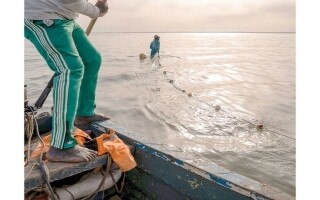
The only ice factory on the island of Bubak in Guinea-Bissau has stopped working, forcing local fishermen, such as Pedro Luis Pereira, to import ice from factories on the mainland, which is about 70 km away, a journey that takes six hours by boat. Pereira, who sets his fishing nets on the island's beach within the protected Bijagós archipelago, says: “The machines have been down for several months, we informed the Ministry of Fisheries, but no one has come to fix them yet.”Wooden boats are the only fishing vessels permitted among the 88 islands of the archipelago. Its shallow waters are a fertile breeding ground for silver sardine, and Pereira races against the tropical heat to sell it fresh for 250 francs (0.33 British pounds) per kilogram at the market in Bissau, the capital of this small West African nation. The tides determine the fishermen's sailing times in the archipelago's shallow waters. For this reason, the area has been classified as a protected zone where all types of fishing are prohibited except for small-scale fishing. Many creatures in this region depend on the sardine, a small oily fish. Previous reports have indicated ongoing illegal and unreported fishing activities that violate national or international laws. Aliu Ba says: “When foreign industrial fishing fleets operating illegally in distant waters deplete these stocks for fishmeal and fish oil to feed animals instead of feeding the people of West Africa, the consequences fall heaviest on small-scale fishermen and coastal communities who have no alternative.”Beatriz Górriz, an activist with the CFFA organization that supports artisanal fishermen in West Africa, stated that the fishmeal industry in Guinea-Bissau is expanding significantly, driven by the over-exploitation of small pelagic fish and rampant illegal fishing. This poses a direct threat to artisanal fishermen and women working in fish processing, as well as negatively impacting the region's food security. She explained that the omega-3 fatty acids found in sardine and other small pelagic fish are a staple of the local diet, especially in a country where 22% of the population suffers from malnutrition. Meanwhile, Aliu Ba, an ocean activist with Greenpeace, emphasized that sardine is not just a commodity but a primary source of protein for millions of people across West Africa.The Expansion of “Fishmeal” Production“Fishmeal” produced on one of the “floating factories.”Analysis of commercial data by The Guardian and DisMog shows that these fish products find their way into international supply chains. Aliu Ba, an ocean activist with Greenpeace, stated: “The Bijagós archipelago is one of the most important marine areas in West Africa ecologically and one of the last relatively intact coastal ecosystems on the African continent.” He added: “Any illegal fishing within the Bijagós marine protected area is not only a violation of Guinea-Bissau's laws but a direct threat to biodiversity and the food and livelihoods of local communities.”New EvidenceThe vessel “Hua Xin 17,” a relatively new ship in these waters, spent 157 days at sea in 2025, about 50 km from the coast of Orango Island, famous for being home to the rare sea cow. The Guardian’s discovery of this vessel is new evidence of the expansion of fish processing operations in Guinea-Bissau, where hundreds of tons of fresh fish are processed daily. Another floating fish processing factory is the “Tian Yi He 6,” which spent about 244 days at anchor at sea in 2025, emitting black smoke 60 km from Orango Island. The “Tian Yi He 6” has operated as a fish processing factory near the Bijagós for about five years and has a history of violating Guinea-Bissau's laws. The Norwegian non-profit SkyTruth tracks fishing information and collaborates with Guinea-Bissau's fisheries inspection agency, monitoring anchored fish processing factories since 2019, when the “Tian Yi He 6” first returned to China in early 2020. SkyTruth's intelligence reports, supported by analysis from the Joint Analytical Cell, reveal ongoing violations of fisheries and transshipment laws in Guinea-Bissau. Fishing is conducted using purse seine nets, long and deep nets that gather large quantities of fish, increasing the catch size.Government LicensingAccording to data from the non-profit Fishing Watch, satellite images showed a group of six foreign fishing vessels at sea supplying the anchored factories. These vessels hold fishing licenses within Guinea-Bissau's Exclusive Economic Zone, a maritime area extending about 322 km from the coast where fishing is permitted by government license. The “Hua Xin 17” and “Tian Yi He 6” are within this zone. Its sandy shores are a nursery for countless species, leading some scientists to call it “the Galápagos of West Africa” due to the large populations of endangered sea turtles and dugongs. However, transshipment at sea or fishing within the protected Bijagós area is prohibited within this zone. Satellite images from Global Fishing Watch indicate that many of the vessels supplying the anchored factories are engaging in illegal fishing within protected areas. Satellite monitoring records from the fisheries agency show that these vessels disable their signals and identification upon approaching the boundaries of the forbidden Bijagós zone. The company “Skretting” stated it has initiated an internal investigation into these findings. Sardine is vital food for migratory birds like the lesser black-backed gull, which overwinter in the Bijagós in their tens of thousands, as well as a primary food source for fish (barracuda and jack), whales, and dolphins in the open sea. However, these schools of pelagic fish attract another, more ruthless predator: industrial fishing vessels that operate on the borders of the protected marine zone, where they are theoretically barred. Among the vessels patrolling this area in 2025 was the “Hua Xin 17,” which is about 125 meters long—longer than a football pitch. Antonio also spoke of the difficult conditions faced by the Guinean crew members, claiming they were mistreated by the ship's managers. The Source of the Expansion The expansion of “fishmeal” production on “floating factories” in Guinea-Bissau comes after attempts by its northern neighbors—Mauritania, Senegal, and The Gambia—to curb the industry's growth on land, which has seen a massive boom in the region over the past decade. Paulo Catry, a biologist who has studied the aquatic life of the Bijagós for 30 years, believes that “the rampant fishing by the industrial fishing industry to the north may be why the fleets have moved to Guinea-Bissau.” Products from the “Tian Yi He 6” floating factory were exported to companies in South America. This vessel is registered as a cargo ship in maritime databases, but a new investigation by The Guardian and DisMog revealed that this foreign-owned vessel is actually a floating factory that processes fresh sardine into other fish products, particularly fish oil on a massive scale. Testimonies from witnesses, exclusive video footage, and satellite data show that a fleet of smaller boats supplies the “Hua Xin 17” and appears to have been illegally fishing for sardine within the Bijagós port. This vessel is one of two anchored at sea operating in the fish processing industry, processing hundreds of thousands of tons of freshly caught sardine into other fish products. The company “Skretting” stated it adheres to a “zero-tolerance policy” towards illegal, unreported, or unregulated fishing or any activities that violate fisheries or environmental laws, and that it is “committed to taking necessary action based on any findings and implementing corrective and legal measures as necessary.”Difficult Conditions A testimony from one worker on the “floating factories,” a sailor named Antonio, corroborated the accuracy of the vessel movement records and alleged activities. He recounted spending seven months in 2024 on board the “Hua Xin 17,” where 25 crew members worked in six-hour shifts to process sardine on board. He added that a smaller boat was responsible for transporting bags of “fishmeal” to the port of Bissau before returning loaded with supplies. He said the management crew had separate food and private cabins, while the Guinean workers slept in two-tier bunks, with each compartment holding 10 people. Antonio told The Guardian during an interview in a Bissau port café: “They don’t consider us equal to them.” This is unacceptable. A source from the company “Skretting” confirmed that the company “Jesses S.A.” purchased a quantity of fish from Guinea-Bissau in 2023 but stated in a response to The Guardian that it could not “verify the claims or whether the fish was caught within the marine protected area.” The source added: “At the time, the documents we received from our trader indicated that the product complied with all local regulations. The company confirmed that “ensuring responsible and legal supply is fundamental to how we operate.” The Chinese company “Bissau Wang Shan” sold products to Chile, the world's largest salmon producer, and also shipped a total of 440 tons worth $1.7 million in 2023 to “Jesses S.A.,” a company based in Ecuador that produces shrimp feed under Skretting's aquaculture feed division. Vera Cuéllor, the executive director of the non-profit organization Oceana in Europe, stated: “Fishmeal and fish oil can enter the European Union market without documentation proving the fish species or its origin.”